


A routine WooCommerce change can be small on paper and still take weeks to reach a verified result.
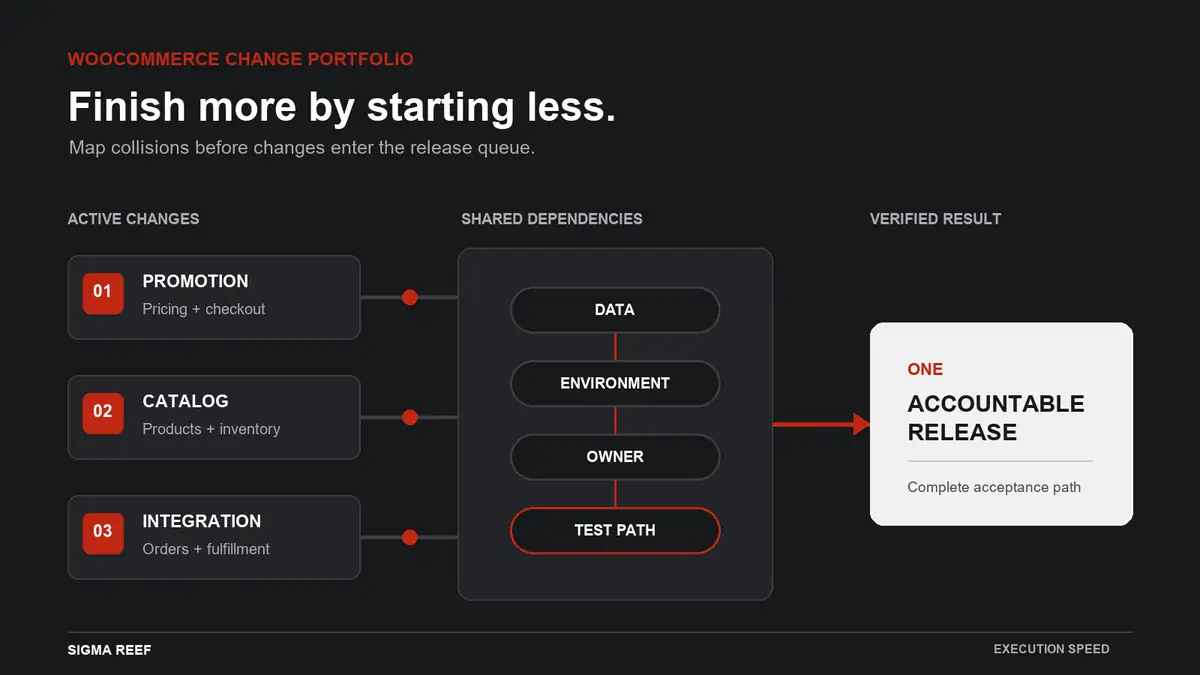
The work itself may not be difficult. The delay often comes from everything already moving at the same time. A promotion changes pricing rules while a catalog update changes product data. A plugin release changes checkout behavior while an integration project changes the order payload. Marketing, operations, developers, and vendors each hold part of the acceptance path.
Every request may have a sensible owner. The release queue can still behave like nobody owns the whole system.
The practical question is not, “How quickly can this ticket be completed?”
It is, “How many active changes are competing for the same dependencies, and which complete commercial outcome should finish first?”
More activity can produce less finished work
A growing WooCommerce team usually has no shortage of priorities. Merchandising needs a product launch. Marketing needs a campaign. Operations needs a fulfillment rule corrected. Finance needs cleaner reporting. Customer service needs better order visibility. The technical team needs to maintain plugins, integrations, hosting, and security.
Starting each request immediately feels responsive. It also creates a large portfolio of partially completed changes.
Those changes compete for shared resources:
- the same staging environment;
- the same product, customer, and order data;
- the same developers and business owners;
- the same plugin and integration dependencies;
- the same release windows;
- the same acceptance-test capacity;
- the same people who can resolve trade-offs.
When too many changes are active, each one waits. Context shifts. Requirements age. Test results become harder to attribute. A completed component may sit idle while another contributor catches up. Leadership spends more time reprioritizing work that has already started.
The operating constraint is not always delivery capacity. It may be uncontrolled work in progress.
A release queue is a portfolio, not a ticket list
A ticket describes a requested component change. A release portfolio shows how active changes interact across the business.
Consider four ordinary requests:
- launch a new bundle;
- change the free-shipping threshold;
- update the checkout extension;
- revise the order export sent to fulfillment.
Viewed separately, each request has a scope. Viewed as a portfolio, they share catalog data, cart logic, checkout, order records, fulfillment behavior, and reporting. Testing one request while the others are moving can hide which change caused an unexpected result.
The queue therefore needs two views.
The first is the commercial view: why the change matters, when the outcome is needed, and what consequence follows from delay or failure.
The second is the system view: which workflows, data, tools, vendors, environments, and acceptance paths the change touches.
A priority decision made with only one view is incomplete. Commercial urgency without the system view creates collisions. Technical sequencing without the commercial view optimizes activity rather than business value.
Map dependency collisions before committing
Before a request becomes active work, create a compact change record. This is not a long specification. It is the minimum information required to identify where the change can collide with work already in progress.
Record:
- Business outcome. What should be different for the customer or operation?
- Accountable owner. Who can make scope, timing, and trade-off decisions?
- Workflow boundary. Where does the affected path start and finish?
- Systems and data. Which WooCommerce objects, plugins, integrations, or external platforms are involved?
- Shared dependencies. Which environments, vendors, rules, or owners are also being used by another active change?
- Acceptance path. What complete scenario must pass before the result is considered finished?
- Release constraint. Is there a commercial date, operational blackout, dependency sequence, or recovery requirement?
- Evidence. What verified internal measure or observation will show whether the change worked?
Compare this record with every active item. A collision does not automatically mean one request must stop. It means the sequencing decision must be explicit.
Two changes may be safe to run together when they affect separate workflows and can be tested independently. They may need to be sequenced when they alter the same checkout rule, order field, integration mapping, or source of truth. The team should make that decision before both changes consume capacity.
Limit work in progress at the system level
Individual contributors can be busy while the portfolio remains stuck. A useful work-in-progress limit therefore applies to complete changes, not just tasks assigned to one person.
Choose a small number of active commercial outcomes that the organization can design, implement, test, release, and verify without overloading shared dependencies. The correct limit depends on the team, architecture, vendor model, and risk. It should be based on observed completion behavior rather than an arbitrary universal number.
An item enters active work only when:
- the accountable owner is named;
- the outcome and boundary are clear;
- material dependencies have been checked;
- the required contributors have capacity;
- the acceptance path is defined;
- a release and recovery path is plausible.
If those conditions are not met, the item remains in a ready queue. Keeping a request ready is more honest than starting it symbolically and allowing it to wait inside the system.
When an urgent request arrives, do not silently add it to active work. Decide which current item will pause, what state it is left in, and what cost follows from the switch. Urgency should change the portfolio deliberately, not expand it invisibly.
Sequence around complete acceptance paths
Teams often sequence work around who is available. That can optimize one component while leaving the commercial workflow unfinished.
Sequence changes around the path that must be verified.
For a promotion, the acceptance path may include product eligibility, price display, cart behavior, checkout totals, tax and shipping interaction, order records, fulfillment instructions, customer communication, and reporting. For an integration update, it may include the originating event, field mapping, delivery, retry behavior, downstream processing, exception visibility, and reconciliation.
A change is not finished because code was merged, configuration was saved, or one vendor closed a ticket. It is finished when the accountable owner has evidence that the complete intended path works and material exceptions remain controlled.
This definition makes queue decisions clearer. If one item is close to completing its acceptance path, finishing it may release more capacity than starting another high-profile request. If a blocked item cannot progress, the owner can remove it from active work rather than allowing it to occupy attention indefinitely.
Use one owner for the release outcome
Several specialists may contribute to a WooCommerce change. One person still needs to own the complete result.
The release owner should:
- maintain the commercial and system views;
- identify dependency collisions;
- decide when the item is ready to enter active work;
- coordinate internal and external contributors;
- protect the agreed acceptance path;
- approve scope trade-offs or escalate them;
- confirm the recovery plan;
- verify the result after release;
- close the change only when evidence is recorded.
This role does not replace technical, operational, marketing, or vendor expertise. It prevents the work between those responsibilities from becoming unowned.
For high-consequence changes, separate implementation approval from release approval. The specialist confirms that the component meets its requirements. The accountable owner confirms that the complete business path is ready.
Make blocked work visible
A blocked item should not look active and healthy.
Record the exact blocker, the owner who can resolve it, the next decision, and the date on which the portfolio will reassess it. Common blockers include missing product data, an unavailable vendor, unclear policy, an unstable environment, another change occupying the same dependency, or acceptance criteria that the business has not decided.
Then choose one of three actions:
- Resolve it now. Assign the decision or dependency and protect the capacity required.
- Defer it. Return the item to the ready queue with its context intact.
- Stop it. Close the request when its commercial value no longer justifies the dependency or delay.
Leaving blocked work open without a decision creates a false picture of capacity. It also increases the cost of restarting because assumptions, environments, and contributors change while the item waits.
Protect the release from late scope
Late additions are especially expensive when they alter the acceptance path.
Once an item enters release preparation, new requirements should trigger an explicit choice:
- include the new scope and accept a revised test and release plan;
- move the new requirement into a later change;
- stop the current release because the original outcome is no longer useful.
Do not allow an informal addition to bypass dependency review. A small field, rule, audience segment, or reporting request can introduce a new source of truth, plugin interaction, vendor handoff, or exception path.
The purpose is not rigid process. It is to keep the release boundary knowable enough to verify.
Measure flow from commitment to verified result
Use internal evidence to determine whether the release system is improving.
Useful measures may include:
- active changes by workflow and shared dependency;
- elapsed time from commitment to verified result;
- time spent blocked;
- changes returned for missing requirements;
- releases delayed by dependency collisions;
- rework caused by another concurrent change;
- items started but not completed;
- post-release exceptions linked to an untested path.
Interpret these measures by mechanism. A long elapsed time may come from unclear decisions, unavailable specialists, unstable environments, oversized scope, vendor queues, or excessive concurrency. The measure identifies where to investigate; it does not prescribe the fix by itself.
Establish a baseline from verified internal records. Label estimates as estimates. Review the same measures after changing the work-in-progress limit or sequencing rule.
Run a weekly change-portfolio review
A short operating review can keep the queue controlled.
For each active change, ask:
- Is the commercial outcome still worth completing?
- Is the accountable owner present?
- What complete acceptance path remains?
- Is the item blocked, and by whom or what?
- Does it collide with another active change?
- Should the team finish, defer, or stop it?
- Which evidence will close it?
Then review the ready queue. Admit new work only when the portfolio has capacity and the required dependencies are available.
This review should produce decisions, not status narration. The result is a visible sequence of outcomes the team can actually complete.
Finish more by starting less
WooCommerce execution slows when commercially important changes compete invisibly for the same data, systems, environments, owners, vendors, and test paths.
Make the portfolio visible. Map collisions before commitment. Limit active outcomes. Sequence around complete acceptance paths. Give one person ownership of the release result. Remove blocked work from the appearance of progress. Measure time to verified completion.
The goal is not less ambition. It is a release system that converts priorities into finished, accountable commercial outcomes.
If your WooCommerce roadmap keeps expanding while completed outcomes slow down, take the Growth Constraint Scorecard to identify the system constraint before starting the next change.